



BELLMEAD, Texas (KXXV) — A Bellmead police officer shot a family’s dog during a welfare check on March 3. The dog, Honey, survived the incident, and newly released body camera video is providing answers about what happened.
Watch the full story here:
Shayna Draper and her family waited weeks to see the video to understand why the officer fired his weapon in their yard.
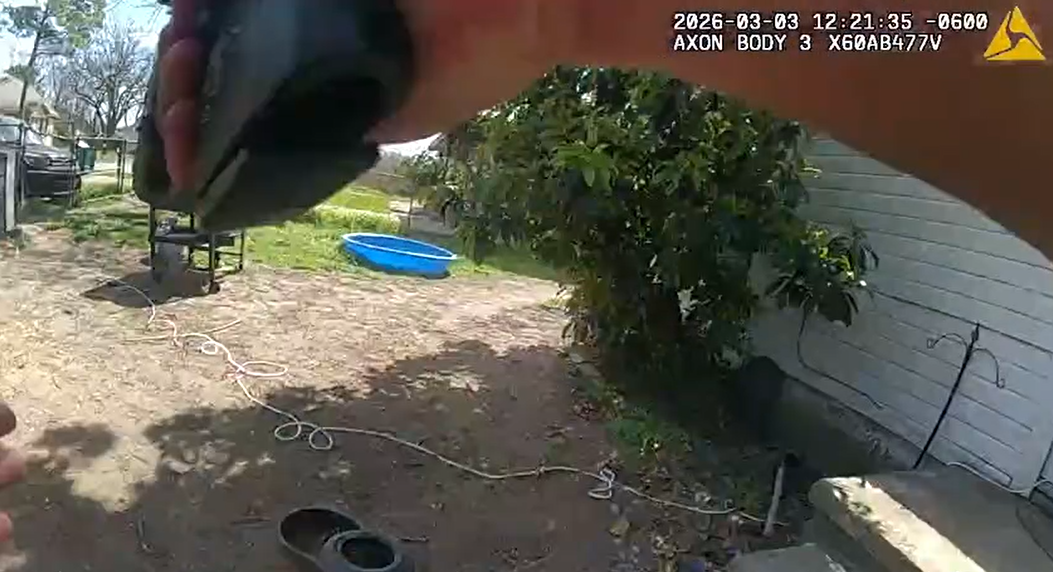
"It was hard to watch, but I mean it all happened so fast." Draper said.
"I can understand where the officer might have felt scared or threatened because she did run up on him out of nowhere, so it does hurt me to see that happen to her, but he's only human, and everybody gets scared sometimes," Draper said.
Police said officers were investigating reports of a decaying smell when one entered a fenced yard to check on the home. Police noted there were no posted signs about dogs in the yard before the incident.
Bellmead Police Chief Shawn Myatt told 25 News and the body camera video shows the officer was confronted by the dog and had only seconds to respond.

"It's definitely been hard on us, but I just decided that, everybody makes mistakes and sometimes bad things like that happen, but although we do feel like they could have handled it differently, I just had to accept the fact that I can't hold it against them. I can't harbor anger towards them," Draper said.
Police and animal control took Honey to a veterinarian for treatment. The family has since filed an insurance claim with the city to cover the veterinary costs.
An open records request of the department’s internal review stated that after reviewing the body camera video and the officer's narrative, "the use of force was justified within department policy" due to the nature of the call. An internal investigation found the officer followed department policy.
"While we understand the emotional impact this incident has had on the family, our officers responded to what they believed could have been a serious welfare situation. We regret that the incident resulted in injury to Honey, and we recognize this was distressing for everyone involved," Myatt said.
Draper said she is sharing her story to warn other pet owners.
"Normally, if you have a fenced-in yard, you would think, ok, my dogs are safe to roam around without any problem. So, I just wanted people to know that things like that can happen and you won't even expect it, so anybody that has loose dogs running around, they need to definitely at least put a sign up to let people know, hey, we have dogs in our yard," Draper said.
Draper told me Honey is doing well and recovering, but is still shaken up. She hopes her dog will be back to normal soon.
The Bellmead Police Department provided the following responses to follow-up questions regarding the incident:
Question: What information did officers have before they arrived on scene?
Answer: Prior to arrival, the information provided to officers was limited to a report of a strong odor believed to be something decaying, potentially a human body. Based on that information, officers responded to investigate what was reported as a potentially serious welfare concern.
Question: Why did officers decide to enter the yard?
Answer: The officer was attempting to get closer to the residence in order to determine whether the odor of decay was coming from the home itself. Based on law enforcement experience, when there is a potential smell of a decaying body, it often indicates that no one else is actively residing in or monitoring the home, as someone present would typically have already identified the issue and contacted emergency services. Additionally, officers do not have prior knowledge of who or how many individuals may be inside a residence when responding to this type of call. As a result, actions such as honking a horn or using a siren are not considered practical or appropriate in these circumstances, as they do not effectively address the potential need for an immediate welfare check. Officers must make decisions based on the information available at the time and their training and experience. In this case, the officer used his discretion to move closer to the residence to assess whether there was an urgent situation requiring immediate intervention. It is also important to note that, prior to this incident, the property was not posted with clearly visible warning signs such as “Beware of Dog,” nor was the gate secured. These factors limited the officer’s ability to anticipate the presence of an aggressive animal. All of this information was explained to the residents on scene the day of the incident.
Question: Can you explain how officers approach welfare checks and calls for something like a decaying smell?
Answer: Calls involving a possible decaying odor are treated seriously because they may indicate a medical emergency, unattended death, or other urgent circumstance. While there is not always one fixed procedure for every scenario, officers are expected to assess the situation based on the information available, observe their surroundings, and use reasonable judgment in determining how to safely investigate further.
Question: Were there any non-lethal options or protocols for the moment the officer feared for his life? My research indicates tasers could be ineffective against dogs, is that true?
Answer: In rapidly unfolding situations, particularly those that develop in a matter of seconds, non-lethal options may not always be practical or effective. In an instantaneous encounter involving an aggressive animal, an officer may have only a split second to react to protect himself. Less-lethal tools can present limitations in those circumstances, including delayed effectiveness and accuracy concerns. In general, tools such as Tasers are not always reliable or practical when used against animals, particularly during a sudden attack situation.
Question: Why did the officer mute his body camera while on the scene?
Answer: As permitted by department policy, the officer briefly muted his microphone in order to communicate with ranking and supervisory officers about the situation. The microphone was unmuted for the duration of the encounter thereafter.
Question: How has the police department followed up with the family since the incident?
Answer: Immediately after the incident, department staff gathered Honey and transported her to a veterinarian for medical care. During that process, Honey had to be muzzled to prevent her from biting staff while they were attempting to get her the treatment she needed. Department personnel later followed up and, after speaking with the family, learned that Honey had been released back to them following treatment. The family was also provided information regarding the process for filing a claim.
Question: What should residents know about how to help prevent similar situations?
Answer: Residents can help reduce the likelihood of similar incidents by making sure their property is properly secured and that any potentially dangerous animals are contained. Gates should be kept closed and secured, and clearly visible warning signs, such as “Beware of Dog,” should be posted where appropriate. These precautions are important not only for first responders, utility workers, delivery personnel, and visitors, but also for children, elderly individuals, or persons with special needs who may unknowingly enter an area and be placed at risk. Clear signage and secure enclosures can help prevent avoidable injuries and give others proper warning before approaching a property.
Question: What is the status of the internal investigation?
Answer: A review of the incident has been completed, and the officer was found to have acted within department policy.
Question: Is there anything else you wish to be included or mentioned from your department in the story?
Answer: While we understand the emotional impact this incident has had on the family, our officers responded to what they believed could have been a serious welfare situation. We regret that the incident resulted in injury to Honey, and we recognize this was distressing for everyone involved. At no time was it the intent of officers to come to the residence and harm Honey; rather, they were responding to a call for service and faced a sudden, difficult situation while carrying out their duties. Our department remains committed to serving the community professionally, compassionately, and in accordance with policy and law.
This story was reported on-air by a journalist and has been converted to this platform with the assistance of AI. Our editorial team verifies all reporting on all platforms for fairness and accuracy.


