

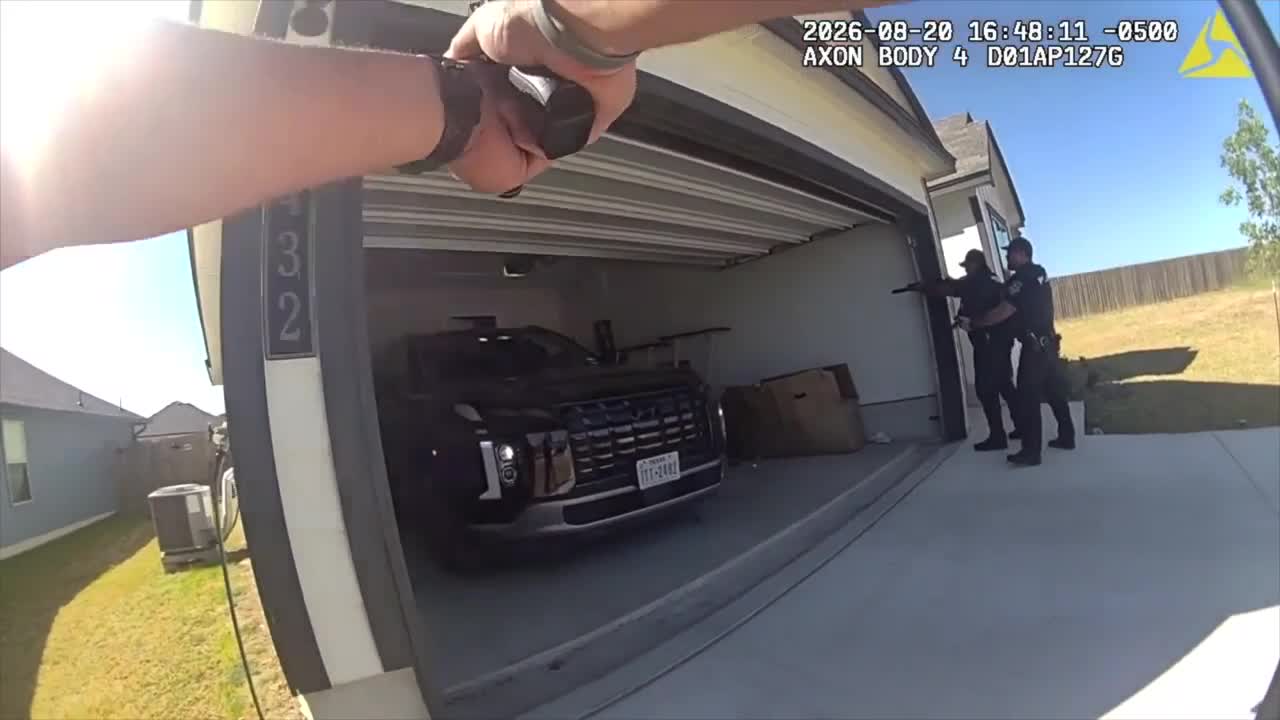


TEMPLE, Texas (KXXV) — As officials release new details about a Temple police response, I spoke with a law enforcement expert to break down the body camera footage.
Last week, 25 News showed exclusive body camera footage of an interaction a Temple mother describes as traumatizing.
"This could've been fatal, and thinking about that is scary, " Kimber said in a previous interview.
In a statement, Temple PD said responders were acting on the information they had been given.
"Both agencies recognize the concerns related to the response that occurred while emphasizing that they were acting on the information available to them at the time.
"TPD and BCECC work together with the community to respond to emergencies and protect public safety. TPD officers respond to the location provided by BCECC, while BCECC dispatches officers based on information received from the 9-1-1 callers. We continue to work together to ensure the right response arrives at the right location for the emergency reported.
VIDEO: Temple family held at gunpoint after police went to wrong address
"Both agencies remain committed to transparency and accountability, and appreciate the same commitment to accuracy and responsible reporting from KXXV."
To get a better scope of the video, I reached out to Dr. Alex Del Carmen, a retired professor of criminology from Tarleton State University. He watched the full, unedited response from Temple police and spoke to the sensitive nature of the response.
"It was nothing more than a miracle that the situation turned out the way that it did," Del Carmen said.
"What you're seeing in these officers is, as they're approaching the house is they are in that mindset on a very tactical mindset, which is, you know, who's gonna open the door, who's gonna be asking for this, what happens if the garage door opens?" Del Carmen said.
Del Carmen said the tense moment when Laticia Kimber was met with officers holding her at gunpoint could have been a turning point for the worse.
"1000 things could have happened. Those situations are so fluid, um, that one second of an error can make a difference in that person's life," Del Carmen said.
"That just breaks your heart when you see this poor kid come out, you know, so scared, seeing all these people with, with rifles, and this kid's mom, you know, with her hands out the window, those memories stay with that child forever, and so I think this is, this is absolutely unacceptable," Del Carmen said.
Once officers realized a child was present, Del Carmen explained how you see the de-escalation tactics come in. He applauded the way the lead officer comforted the child.
"Had you had a police officer there at the scene that was not as calm and collected as the one officer that was there interacting with her throughout the entire event, you could have had innocent people die in the hands of law enforcement," Del Carmen said.
"When he started calling the kid Mijo, you know, I still don't understand why that was even invoked, right, because that's a Spanish name that we use to make reference to our own kids in certain cultures in Latin America. But nevertheless, let's just assume that the best intentions...I don't know if there is a better way of handling that," Del Carmen said.
On the other end, officers were confirming the information they had with dispatch.
"In the 30 years that I've been associated with the field. I can tell you that we've seen instances where dispatchers have given the officers the wrong information or information that is incomplete, um, that prompts the officers to take a stance when they arrive at the scene that was not necessary," Del Carmen said.
"It was a simple mistake, right?...we're all human, but at the same time, this is no different from you and I taking the wrong turn on the highway and going up against traffic and killing somebody as a result of that," Del Carmen said.
He explained the intense environment dispatchers work under.
"Dispatchers, most of them do a phenomenal job in being, being that rate of clearance between the public who is oftentimes calling them in distress, telling them about an event that's taking place before their eyes as they're being traumatized and they're listening to the trauma on the other end of the telephone," Del Carmen said.
Del Carmen said this situation should be an example for improvements within first responders.
"We have to get better not only in our, our technology but also our training, our policies. especially as it relates to dispatchers to make sure that the information that's being conveyed to the officers is accurate. Um, I think this is unforgivable, quite honestly," Del Carmen said.
This story was reported on-air by a journalist and has been converted to this platform with the assistance of AI. Our editorial team verifies all reporting on all platforms for fairness and accuracy.
