

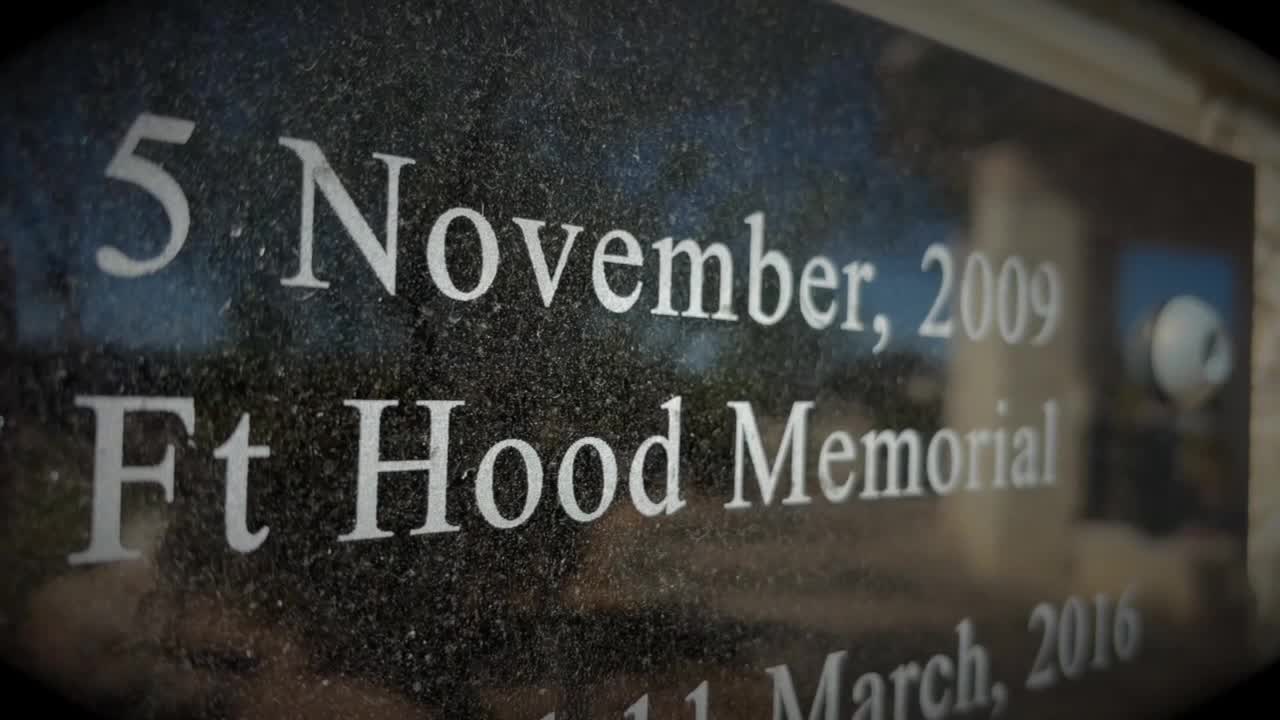


FORT HOOD, Texas (KXXV) — President Trump announced Thursday that the firing squad execution of Fort Hood shooter Nidal Hasan, set for December, will no longer be live streamed.
One survivor said she agrees with the decision.
"Being someone who's already seen something like this on a large scale, watching, seeing what happened that day, upfront, close and personal is not anything I would wish upon anybody to ever have to see," Julia Wilson said.
November 3, 2009, is a date that Wilson will always remember. It was her due date for her son. After grabbing lunch with her mom on post, she went to return to work at the SRP building, but tragedy struck before she could get out.
"I had just backed my vehicle in when the shooting just kind of started erupting. I had previously looked over at our medical building and saw a wounded soldier down on the ground and other soldiers around him," Wilson said.
"I could hear. The screaming I could smell. The blood, a lot of what went through my mind was sheer terror and complete horror. Because I'm thinking they're gonna be cutting my son out of my corpse, I thought I'm never gonna be able to see the face of my child. I'm never gonna get to hold my child," Wilson said.
Wilson said the event has impacted her in more ways than one, and she hopes to be in the room to see justice served.
"It boils down to for me, I'm hoping it provides closure in some aspect, but I also feel like I need to be there to support my other people that were there that were wounded, my families that lost people," Wilson said.
Wilson said returning to work after the shooting brought its own trauma.
"When I did go back to work, I was forced to go in the same building in the same parking lot and have flashbacks every day I was there for an entire year. I had soldiers sit at my desk day after day. 'Oh, you saw more that day than we saw on multiple tours overseas' and I'm supposed to be OK. I'm supposed to just sit there and smile and do my job and act like everything is peaches and cream," Wilson said.
Wilson said as the headlines come up, so do the memories of that day, pointing to a larger effect the event had — causing post-traumatic stress disorder.
"The people who were murdered that day are not the only ones that we have lost to Hasan. Some of us have lost that fight against mental health. Joshua Berry is one of the most known," Wilson said.
Sean Timmons, a military law attorney in Houston, had arrived at Fort Hood just weeks prior to the shooting. He said the livestream element could have complicated the execution timeline, potentially violating Hasan's rights.
"It's good that it was canceled. It's concerning that it was even proposed. However, it's enlightening that many people did oppose it and maybe it was a step too far even for this president. So that was, that was a positive. I would take the cancellation as a positive," Timmons said.
Timmons said the Eighth Amendment could have come into play had the livestream moved forward.
"It's certainly disturbing to say the least. Whether it's technically legal, that's to be determined. I think the Eighth Amendment, though ban on cruel and unusual punishment would weigh heavily on a public execution being too humiliating of a punishment for not only the victim, but the family of the victim who be collaterally punished by such a public display of an execution like that," Timmons said.
Timmons was also on post the day of the shooting.
"I remember hiding in my office while everyone else was told to take cover and a couple of my colleagues were at the SRP site where people were being murdered. I think it was an act of humanity that Major Hassan was spared from death at the time of him being stopped during his process of committing a massacre," Timmons said.
Timmons also addressed why he believes the livestream was proposed in the first place.
"It's disheartening to see that this was even announced to begin with, but I think the theory behind it was generate, you know, the base to get them all fired up and get out the vote and throw a bone to the base, hoping to show up and vote in a couple weeks. That was probably the intent behind it. I don't know if there was an actual serious intent to live broadcast it on a live stream. I hope not, actually, because that's pretty cruel and unusual and pretty drastic," Timmons said.
Lt. Col. Allen West, executive director of the American Constitutional Rights Union (ACRU), witnessed another military shooting in 2003 in Kuwait. West said while he applauds the government for finally serving justice, he wants them to continue the momentum for others on death row.
"I'm not one for theatrics. I'm not one for drama, and I think the most important thing is we don't need to be debating the means by which of his demise we should be remembering what he did and the traitorous action that he took," West said.
West called for another military convict to face the same punishment as Hasan.
"There was another United States Army soldier, Sergeant Hassan Akbar, who killed two and also wounded 14 back in March of 2003 at Camp Pennsylvania in Kuwait, he is still on death row there, and I think that both of them should be receiving the exact same execution by firing squad right there at Fort Leavenworth," West said.
Wilson is also continuing to push for recognition of other survivors for heroic efforts and mental health resources they never received.
This story was reported on-air by a journalist and has been converted to this platform with the assistance of AI. Our editorial team verifies all reporting on all platforms for fairness and accuracy.
