

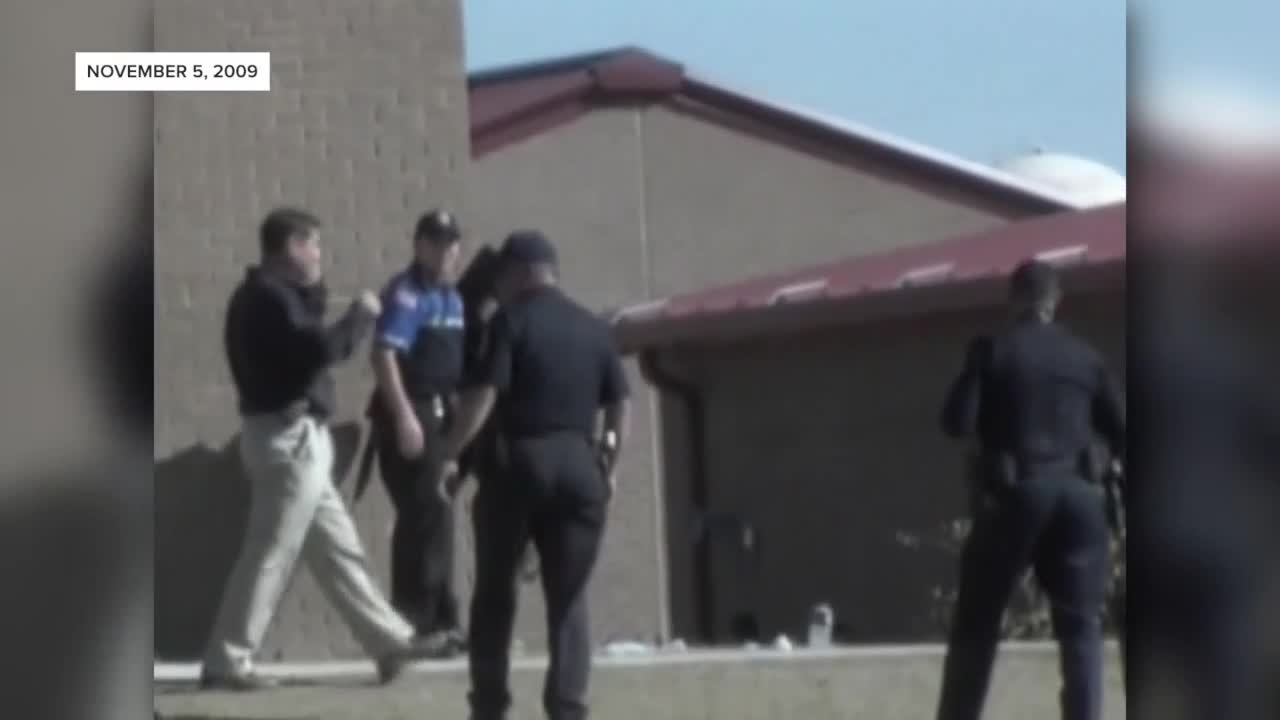


KILLEEN, Texas (KXXV) — Nearly 17 years after a mass shooting at Fort Hood killed 13 people and injured 32, the acting secretary of the Army set Dec. 3 as the execution date for former Army Maj. Nidal Hasan.
The date was set Tuesday night, following the president's approval of the execution earlier this week — but legal experts say the date may not be final.
Military law expert and Yale professor Eugene Fidell says the legal process could push that date back.
"There's nothing common about this case. It's a, it's a unique case," Fidell said. "The biggest question now is whether Dr. Hassan, either on his own or with the benefit of attorneys, will go to federal court to try to stop the train at this point, or at least slow it down."
"The biggest question surrounding Dr. Hassan's case right now is whether he's going to seek a writ of habeas corpus from a federal district court to set aside his sentence or his conviction. This happens commonly in capital cases and death penalty cases, but it's unclear whether he's going to go in that direction," Fidell said.
"Given what he has said and done, he seems to have felt a desire to become a martyr. If that's the case, then he probably will not want to seek habeas corpus from federal court," Fidell said.
"And if he doesn't seek habeas corpus from federal court, then the execution will proceed. If he does seek it, he will outlive the Trump administration because it will be years before habeas corpus is finally resolved, going through several tiers of the civilian federal courts," Fidell said.
The Army has used a firing squad as a method of execution several times, with the last case in 1945. Stephen Jewell, an Austin-based military law attorney with Tully Rinckey PLLC, says that while the method may seem symbolic, it is routine for the military.
"We haven't done this in a long, long time, since the early 60s. The firing squad has historic connections to military service, that is how a lot of executions have been carried out within the history of the United States, knowing that this hasn't happened in a long time. With various difficulties with lethal injection, things like that, that have also been in the news recently, you can only speculate, but, this seems to be very, part and parcel as far as a military function," Jewell said.
"So a good analogy or a similar case to this was the Private Gray case in 2008. It had already been through the process, it had already been denied by the Supreme Court or not heard, and then like there was an execution date set. What happened is his team filed a stay motion with the district court in Kansas, which is where these guys are held at the disciplinary barracks, and that was granted, and that case has been in limbo ever since," Jewell said.
Scott Walters, a military law attorney with O'Connell West, PLLC, who served at Fort Hood until 2008, says the public should remember the weight of the courts in the final say on the execution.
"This is an extraordinarily serious punishment, and reasonable people can have very strong views about it on both sides. The question for the courts is narrower, right? The courts are only concerned with, is there a legal basis to stop or delay the execution? People should also be cautious about social media reports and headlines suggesting, suggesting that an execution is either certain or imminent," Walters said.
"There's gonna be enormous attention from the media, the public, elected officials, and legal observers. So I would expect the military to be extremely deliberate and intentional," Walters said.
Families and friends of victims I spoke with on Tuesday say that as the 2009 attack continues to make headlines, they want the victims and their stories remembered.
This story was reported on-air by a journalist and has been converted to this platform with the assistance of AI. Our editorial team verifies all reporting on all platforms for fairness and accuracy.
