

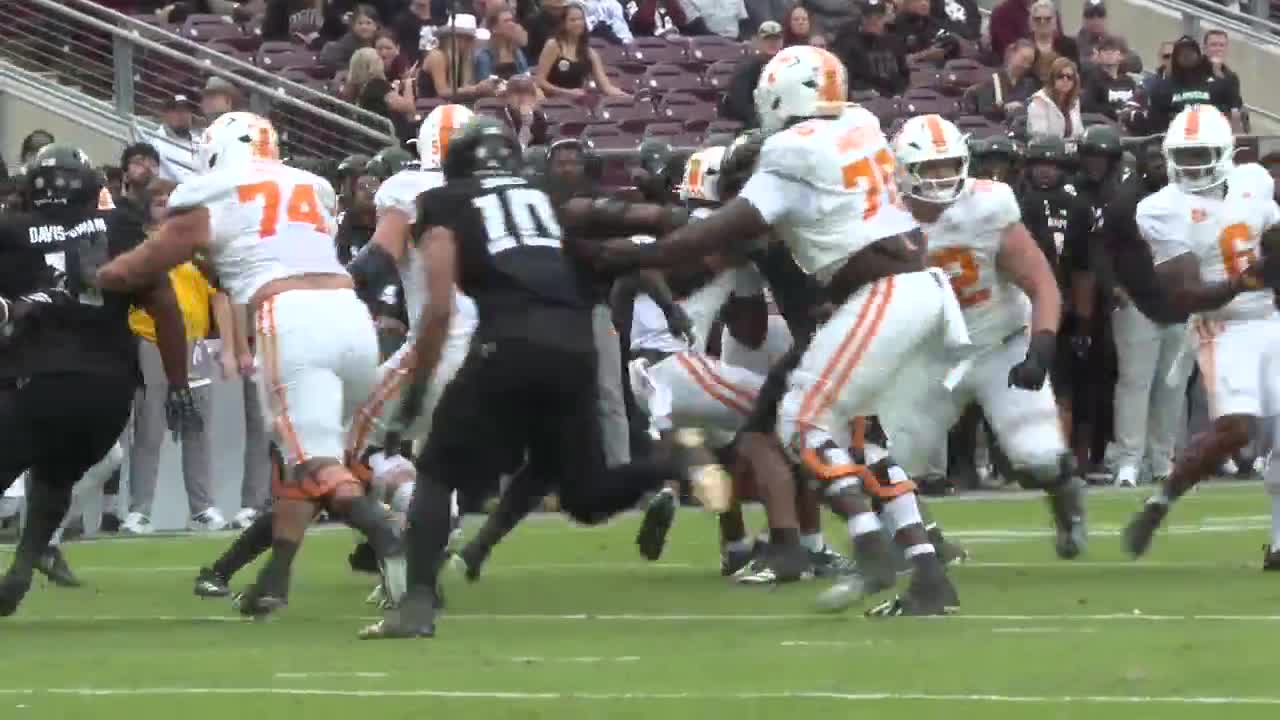


COLLEGE STATION, Texas (KRHD) — A packed Kyle Field crowd expected Texas A&M to respond, but instead watched an offense struggle to find answers in a 22-7 loss to Tennessee. Mike Elko took responsibility for the performance, while the Aggie defense continued to fight despite spending more than 42 minutes on the field.
Texas A&M returned to Kyle Field looking for answers, but the Aggies left with more questions than they had entering Saturday's matchup against Tennessee.
— Texas A&M Football (@AggieFootball) November 14, 2026
In front of a crowd of more than 108,000 at Kyle Field, the Aggies suffered a 22-7 defeat to the No. 8 Volunteers, extending their struggles during a season that has increasingly slipped away from them. What began as an opportunity to get back on track turned into another frustrating afternoon for an offense that could not sustain drives, establish the running game or find consistency through the air.
The final numbers told much of the story. Texas A&M finished with just 179 total yards, including 93 passing yards and 86 rushing yards. The Aggies converted only two of their 11 third-down opportunities, failed to score after halftime and never reached the red zone.
For head coach Mike Elko, the performance was unacceptable, and he made no attempt to disguise his disappointment.
"Pathetic," Elko said when asked to describe the offensive performance in one word.
His frustration went beyond the final score. Following the game, Elko began his postgame press conference with an apology to the fans who filled Kyle Field expecting a better performance from their team.
"An utter apology with everything that I have to everybody who supports this program," Elko said. "Thank you for turning out. You deserve so much better. Give me a chance and we will get this fixed and we'll put a much better product on the field."
It was a difficult admission from a coach who has spent much of the season trying to find solutions to an offense that has struggled to maintain the momentum it occasionally shows early in games.
Saturday's performance represented another significant step backward.
The Aggies entered halftime holding a narrow 7-6 advantage, thanks to a 25-yard touchdown run from K.J. Edwards early in the second quarter. For a brief period, Texas A&M appeared to have an opportunity to build on that lead and give its defense some breathing room.
Instead, the offense disappeared after the break.
Texas A&M's first four possessions of the second half ended in three-and-outs, leaving the defense repeatedly returning to the field without much opportunity to recover. The Aggies managed only 17 yards across those first four drives, and their inability to move the football allowed Tennessee to gradually take control.
The Volunteers eventually outscored Texas A&M 16-0 in the second half, turning a one-point halftime deficit into a comfortable road victory.
Elko pointed to the inability to establish the running game and convert third downs as two of the biggest reasons the offense could never get going.
The Aggies went just 2-for-11 on third down, a significant difference from their previous performance against Missouri, when they had been much more successful keeping drives alive.
"Last week we were able to convert a lot on third down. We were able to put ourselves in position," Elko said. "We are 2 of 11 today. We couldn't hold on to the football. We couldn't get first downs."
Without consistent first downs, Texas A&M could not establish tempo or create momentum. Tennessee's defense was able to dictate the pace, consistently forcing the Aggies into difficult situations and limiting quarterback Marcel Reed's opportunities to make plays.
The pressure from the Volunteers created problems throughout the afternoon, particularly along the offensive line.
Texas A&M struggled to establish protection and create running lanes, and the offensive performance became increasingly predictable as Tennessee adjusted to what the Aggies were attempting to do.
Elko acknowledged that the wind played a role in the passing struggles, but he said Tennessee's pass rush created an even bigger problem.
"The wind played a role. The rush played a bigger role," Elko said. "Our ability to give him any time to see anything."
The offensive line's struggles were particularly frustrating for senior offensive lineman Wilkin Formby, who acknowledged that communication and execution up front were not good enough.
Formby said Tennessee's defensive movement and pressure created challenges, but he believed the Aggies had prepared for those situations during the week.
"I don't know necessarily if it's as much as what they did, but I think it was just a couple of guys on the team up front having small mistakes, me included, and it just kind of spiraled," Formby said.
He added that the offensive line needed to take more control of the situation instead of allowing individual mistakes to affect the entire unit.
The struggles were especially noticeable after halftime. Texas A&M entered the break with 73 rushing yards but finished with just 86, gaining only 13 additional yards on the ground in the second half.
For an offense that has relied on its ability to establish the run, that production was nowhere near enough.
Formby said the team's inability to finish games has become an increasingly frustrating trend.
"Something that is upsetting that I have noticed is, like, we just got to finish better," Formby said. "At these last few games we've come out, we've started fast, we've been playing good and we've had leads and we've been in great positions coming out of halftime and even in the fourth quarter. We just got to finish."
The offensive struggles naturally brought attention to Reed, who has faced criticism as Texas A&M has searched for answers at quarterback. However, Elko was quick to reject the idea that the loss could be placed on one player.
When asked about the possibility of making a quarterback change, Elko said the coaching staff would evaluate the position moving forward. But he made it clear that Reed was not solely responsible for what happened against Tennessee.
"I don't know how you can put this on one kid. This is not on one kid," Elko said. "The narrative that this is just on Marcel, like anybody who watched that game and thinks that is just on Marcel Reed, it's on me. It is on me."
Elko continued by describing the offense as completely nonfunctional and accepting responsibility for the team's inability to produce.
"It is my fault. I own it. Come after me."
That accountability was important considering the problems extended well beyond the quarterback position. Tennessee consistently pressured the offensive line, limited the running game and forced Texas A&M into passing situations that played directly into the Volunteers' defensive strengths.
Formby also defended Reed, emphasizing that the offense needed to improve as a collective unit.
"You can't put the blame on one player. We gotta protect better," Formby said. "There's things all around the offense and the whole team that we gotta do better, and that's why it's a team sport."
While the offense struggled, Texas A&M's defense continued to compete despite spending much of the afternoon trying to keep Tennessee from pulling away.
The Volunteers controlled possession for 42 minutes and 11 seconds, compared to just 17 minutes and 49 seconds for the Aggies. Tennessee also ran 74 offensive plays, 30 more than Texas A&M.
That imbalance put considerable pressure on the Aggie defense, which repeatedly had to return to the field after short offensive possessions.
Despite the circumstances, the defense kept Tennessee from completely taking over the scoreboard early in the game. The Volunteers had several opportunities to create separation but initially settled for field goals rather than touchdowns.
Tennessee running back DeSean Bishop finished with 97 rushing yards on 34 carries, averaging 2.9 yards per attempt. Although the Volunteers eventually found success through their ground game, the Aggies did a respectable job limiting Bishop's production on a per-carry basis.
Elko praised the defensive effort, particularly considering how frequently the unit was forced to play.
"They ran 30 more plays than we did. Time of possession was ridiculous," Elko said. "Just time after time the defense was put in disadvantageous positions and kept going out there and kept playing."
Defensive lineman Daymion Sanford shared that appreciation for the defensive unit's effort. He said the Aggies entered the game understanding the importance of stopping Tennessee's rushing attack and believed the defense brought the necessary physicality.
Sanford also pointed to Tennessee's personnel adjustments as the game progressed, explaining that the Volunteers changed from 12 personnel to 11 personnel and found opportunities to attack the edges of the defense.
"I feel like we came in there in a pretty good mentality," Sanford said. "They were the number one rushing offense in the conference, so we have to come in the right mentality and be physical. I feel like we pretty much did that the whole game."
Sanford said the extended time on the field did not change the defense's approach. Despite the long drives and limited opportunities to rest, the unit continued trying to make stops.
"We love being out there," Sanford said. "We love being physical. We love the run game."
That mentality became increasingly important as Tennessee began controlling the game in the second half.
The Volunteers took their first lead of the afternoon late in the third quarter when Cooper Ranvier connected on a 32-yard field goal to make it 9-7. Tennessee had put together an 11-play drive that consumed approximately six minutes, continuing a trend of long possessions that kept the Aggie defense on the field.
The biggest turning point came in the fourth quarter.
After a lengthy drive, Tennessee quarterback Faizon Brandon connected with tight end Da'Saahn Brame on a five-yard touchdown pass, extending the Volunteers' lead to 16-7 with 9:38 remaining.
Tennessee had found its first touchdown of the afternoon, and Texas A&M suddenly needed an offensive response that had been missing since halftime.
It never came.
The Aggies turned the ball over on downs on their next possession, giving Tennessee another opportunity to add to its advantage. Ranvier connected on a 44-yard field goal to make it 19-7.
An interception by Tennessee's T.J. Metcalf on a pass from Reed later helped set up another Ranvier field goal, bringing the final score to 22-7.
For Sanford, watching the offense struggle while the defense continued trying to keep the team in the game was difficult. However, he said the unit's mentality remained focused on responding to adversity.
"Just like my coach T will always say, you gotta be first responders," Sanford said. "We always have the mentality coming in the game, you know, gotta respond, and we gotta do our job."
Sanford also acknowledged the disappointment of hearing fans boo and watching portions of the crowd leave before the final whistle.
With more than 108,000 people inside Kyle Field, expectations remained high despite the team's recent struggles.
"It's definitely hard," Sanford said. "But, you know, I still believe in our team. We're still pushing. I believe in this culture."
That belief will be tested over the final two games of the regular season.
Texas A&M now finds itself needing two victories to become bowl eligible, with a road matchup against Oklahoma next before returning home for the Lone Star Showdown against Texas.
For a program that entered the season with expectations of competing near the top of the SEC, the current position is far from where it hoped to be.
Still, Formby said the team's approach will not change simply because the circumstances have become more difficult.
"That's the only option. We don't have, that's our only choice is to figure it out," Formby said.
The offensive lineman emphasized that the team's attention must shift toward preparation rather than dwelling on the latest defeat.
"We just wanna put the game to bed tomorrow and get building for an upcoming defense that's really talented and we're gonna play on the road," Formby said.
For Elko, the challenge is finding answers quickly. He said the coaching staff has already made numerous adjustments to the offense, including changes to the running game, passing concepts and tempo. However, those changes have not translated into consistent production.
The head coach also acknowledged that the offense has struggled to find the right answers when opposing defenses make adjustments at halftime.
"Probably not finding the right answers in the second half to their solutions," Elko said.
That admission may be one of the most important takeaways from Saturday's loss. Texas A&M has shown flashes of offensive potential, but those moments have not translated into four quarters of consistent football.
Against Tennessee, the Aggies were unable to sustain anything offensively, leaving the defense with an increasingly difficult assignment and the home crowd with little to celebrate.
The final whistle brought an end to another disappointing afternoon at Kyle Field, but it did not end the questions surrounding the direction of the program.
Elko apologized to the fans and promised that the team would work to deliver a better product. His players echoed the need for accountability, pointing to execution, protection and finishing drives as areas that must improve.
Now, with two regular-season games remaining, Texas A&M has little time to figure things out.
The Aggies must find a way to move the football, protect their quarterback and finish the opportunities they create. Otherwise, Saturday's performance could become more than just another disappointing loss.
It could define the final stretch of a season that has fallen well short of expectations.
