

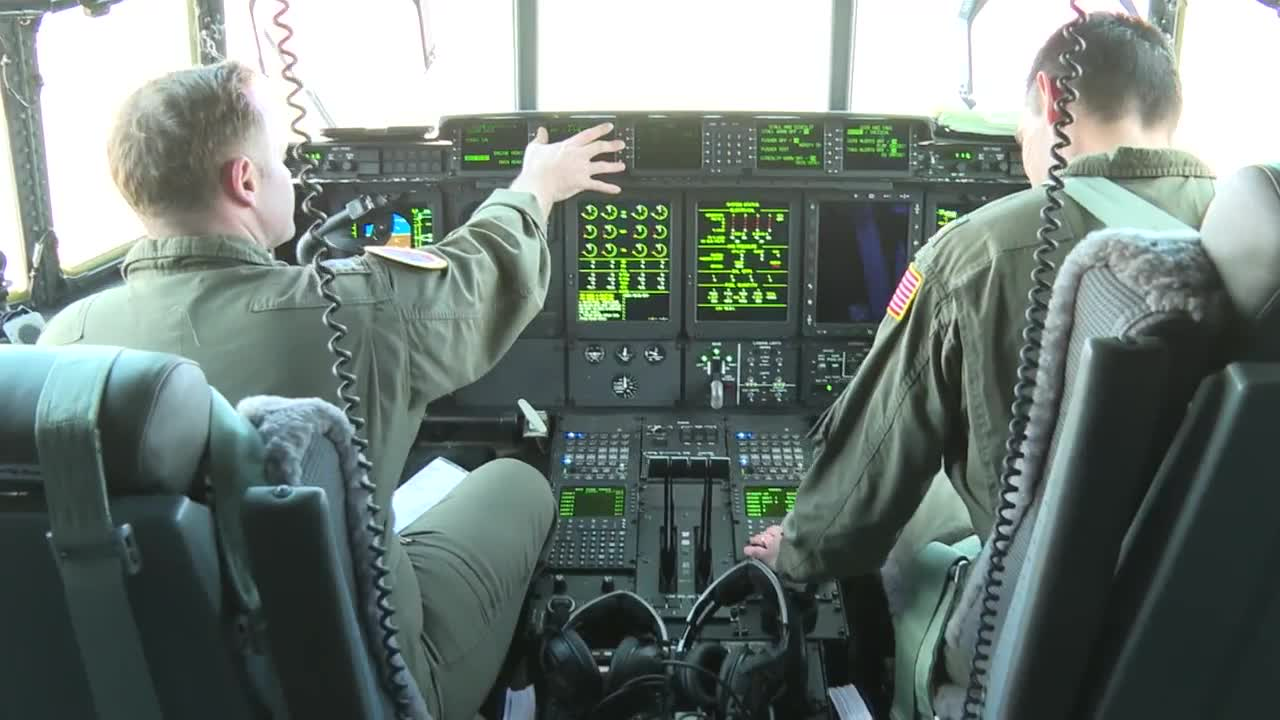


WACO, Texas (KXXV) — After months of work, a formerly bare HC-130 aircraft fresh from Lockheed Martin is now outfitted as a state-of-the-art "Minotaur" Coast Guard search plane at TSTC Airport in Waco.
The aircraft is currently going through test flights and is due to be handed over to the Coast Guard in the next few days, ahead of schedule in what's normally a 12-month regimen of "missionization."
Watch the story here:
"It's such a cool process to see what we call a green aircraft completely unpainted, unmissionized, come to this facility, and then 12 months later, come out," said Coast Guard Lt. Cmdr. Jeff Henkel, Acquisition Deputy Director.
A crew of about 30 has been working on the aircraft as the Coast Guard tries to expand its fleet for missions such as search and rescue out on the high seas.
Six more of the planes are now on order.
Beyond the new paint job, L3 Harris added large external fuel tanks so the aircraft can keep flying for as long as 20 hours. The technology is wired to gather vital information and share it, from the new radar array on the belly to the FLIR turret optical sensing array under the nose.
"That's one very expensive suite of cameras on the front that allow us to see both day and night," Henkel said.
The enhanced capabilities will significantly improve search and rescue operations.
"Let's say somewhere out in the Pacific, there's a small boat that's been lost at sea 8-10 hours from Hawaii. Potentially get on scene the same day, they'd fire up the mission system, hopefully get a return off the radar and then investigate the target with the cameras to effect the rescue," Henkel said.
Bill Kascak, L3 Harris Mission Sustainment Programs Director, expressed pride in the project.
"It's really a pride thing," Kascak said. "I would say Coast Guard is one of our four main customers on this field and we're looking at supporting them for a long time into the future."
Once deployed, the plane will be headed to the Coast Guard station in Sacramento, where the last of its predecessors was retired in 2016. This means it will be the first time that station has had this kind of asset in 10 years.
